Did you get doored while riding in downtown San Diego? If a parked car door opened into your path, California law may give you the right to pursue compensation for this bicycle accident. California Vehicle Code 22517 places a clear legal duty on anyone opening a vehicle door to make sure it is reasonably safe before opening it into moving traffic.
A violation of that statute may establish the foundation for a negligence claim against the person who opened the door, whether that person was a driver, a front-seat passenger, or someone stepping out of an Uber or Lyft.
Table of Contents
- Key Takeaways for Bicycle Dooring Accidents in San Diego
- How California Vehicle Code 22517 Determines Fault in a Bicycle Dooring Accident
- Who Is Liable if an Uber or Lyft Passenger Opens a Car Door Into a Cyclist?
- Why Passenger-Side Dooring Accidents Happen So Often in Downtown San Diego
- How Bicycle Dooring Injuries Differ From Other Bike Accidents
- What Evidence Helps Prove a Parked Car Bike Crash Was the Driver's or Passenger's Fault?
- FAQ for Bicycle Dooring Accidents in San Diego
- Speak With a San Diego Bicycle Dooring Accident Attorney
Key Takeaways for Bicycle Dooring Accidents in San Diego
- California Vehicle Code 22517 prohibits opening a vehicle door into moving traffic unless it is reasonably safe to do so, placing the burden of care squarely on the person opening the door
- Bicycle dooring liability may extend beyond the driver to include passengers, and in rideshare situations, the question of whose insurance applies depends on the driver's app status at the time of the incident
- Passenger side dooring accidents from Uber and Lyft vehicles are increasing in urban areas like downtown San Diego, where rideshare pickups and drop-offs frequently occur in or near bike lanes
- A cyclist doored in San Diego has two years to file a personal injury lawsuit, but claims against a government entity for road design failures require an administrative filing within six months
- Evidence gathered immediately after the crash, including photos, witness contacts, and the rideshare trip details, may be critical to proving fault and accessing the right insurance coverage
How California Vehicle Code 22517 Determines Fault in a Bicycle Dooring Accident
California Vehicle Code Section 22517 states that no person may open a vehicle door on the side available to moving traffic unless it is reasonably safe to do so and can be done without interfering with the movement of traffic. The statute also prohibits leaving a door open longer than necessary to load or unload passengers.
In most bicycle dooring cases, this law puts the initial burden on the person opening the door, not the cyclist traveling past a parked vehicle. The rule applies to both drivers and passengers, requiring them to check for approaching cyclists before opening their doors.
When a person opens a door in violation of Section 22517 and a cyclist is injured, the violation may support a negligence per se argument.
Under California Evidence Code Section 669, violating a safety statute designed to protect a specific group of people from a specific type of harm may create a presumption that the person who opened the door was negligent. Cyclists riding lawfully in a travel lane or bike lane are exactly the people this law was written to protect.
Who Is Liable if an Uber or Lyft Passenger Opens a Car Door Into a Cyclist?
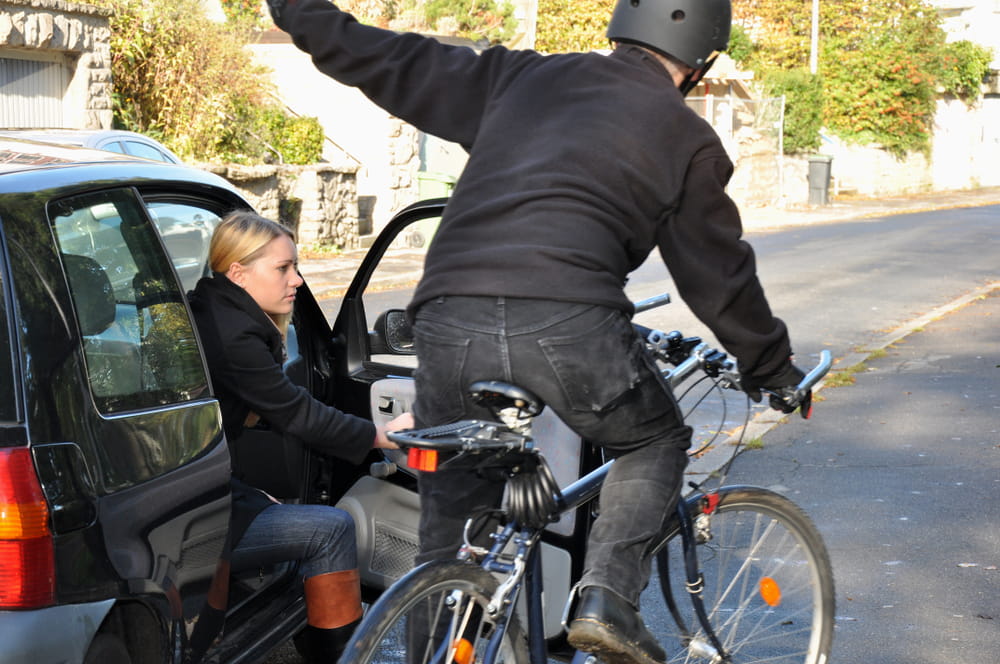
Under CVC 22517, the person who opened the door bears primary liability. In a rideshare dooring scenario, that person is usually the passenger. However, the legal picture is more complex than a standard parked car dooring because multiple parties and insurance policies may be involved.
When the Passenger Might Be Liable
The passenger who opened the door may be personally liable for violating CVC 22517. Their homeowner's or renter's insurance may provide some coverage, but many passengers carry no relevant policy, leaving a potential gap in recovery.
When the Rideshare Driver Might Be Liable
The rideshare driver may share fault if they stopped in an unsafe location, such as in a bike lane or at a spot where the passenger had to exit directly into the path of cycling traffic. The driver's choice of drop-off location may constitute a separate act of negligence independent of the door opening itself.
When Uber or Lyft Insurance May Apply
In a rideshare dooring claim, available insurance coverage often depends on whether the driver was logged into the app, en route to a pickup, or actively transporting a passenger when the door opened. When a passenger is in the vehicle, or the driver is en route to a pickup, a $1 million liability policy generally applies. If the passenger was actively exiting during an ongoing trip, that coverage may extend to the dooring incident.
However, recent changes under Senate Bill 371, signed in October 2025, have reduced certain uninsured and underinsured motorist coverage limits for rideshare policies, which may affect recovery in some cases.
Rideshare companies classify their drivers as independent contractors under California's Proposition 22, which complicates direct liability claims against the company itself. That is what makes rideshare dooring claims harder than ordinary parked-car bike crashes: liability may begin with the passenger who opened the door, but insurance recovery often turns on the driver's conduct and the ride status at the exact moment of the collision.
Why Passenger-Side Dooring Accidents Happen So Often in Downtown San Diego
Not every dooring accident involves the driver's door. Passenger side dooring accidents are increasingly common in urban areas where the passenger door opens directly into a bike lane or the cyclist's line of travel.
Passengers exiting on the curb or bike-lane side of a vehicle often pay less attention to approaching cyclists than drivers, especially in hurried Uber and Lyft drop-offs. They have no mirrors, no habit of checking for traffic, and in rideshare situations, may be focused on their phone or belongings rather than the road.
In downtown San Diego, the Gaslamp Quarter, East Village, and Little Italy see heavy rideshare pickup and drop-off activity along corridors with adjacent bike lanes. The standard width of a California bike lane is roughly four feet, which falls within the swing radius of most car doors. A cyclist at normal speed may have less than a second to react.
San Diego's mix of Class II painted bike lanes and shared-lane sharrow markings offers no physical buffer between cyclists and parked or stopped vehicles. That absence of separation increases both the likelihood of a dooring collision and the strength of an argument that infrastructure design contributed to the crash.
How Bicycle Dooring Injuries Differ From Other Bike Accidents
Dooring collisions produce a distinct injury pattern. The impact is sudden and frontal, often launching the cyclist over the handlebars with almost no time to brace.
Injuries commonly tied to dooring crashes include:
- Wrist and hand fractures from instinctive bracing against the door or pavement
- Clavicle breaks from direct impact with the door frame or the force of landing
- Facial trauma, including lacerations and dental injuries, when the cyclist is thrown forward
- Concussions and traumatic brain injuries from uncontrolled falls onto pavement
- Shoulder separations or rotator cuff damage from landing on an outstretched arm
- Road rash and deep skin lacerations from sliding across asphalt after the initial impact
These injuries are often compounded by what happens next. A cyclist thrown from the bike may land in an adjacent travel lane, creating a secondary collision risk with moving vehicles. Documenting each injury and its connection to the dooring event strengthens both the liability and damages components of a claim, which is why early medical evaluation and thorough evidence gathering matter.
What Evidence Helps Prove a Parked Car Bike Crash Was the Driver's or Passenger's Fault?

The strength of a bicycle dooring claim often depends on what was documented in the hours and days after the crash. Evidence that disappears early is difficult to reconstruct later, and insurers may use gaps in documentation to challenge fault or causation. Information and documentation that may help your claim includes:
- Police report: A report that references CVC 22517 strengthens the liability foundation. If police were not called at the scene, filing a report after the fact is still worth pursuing.
- Identity of the person who opened the door: The name, contact information, and insurance details of the person who opened the door are critical. For rideshare incidents, the vehicle's make, model, license plate, and any visible company markings help connect the claim to the right insurance policy.
- Rideshare trip details: The rideshare app records the driver's status, pickup and drop-off locations, and the timing of each trip phase. This data may determine which insurance coverage applies and should be requested as early as possible.
- Photos of the scene: Images showing the position of the vehicle, the open door relative to the bike lane, roadway markings, visible injuries, and bicycle damage all support the claim. Wide-angle photos that capture the relationship between the parked vehicle and the cyclist's line of travel are especially useful.
- Witness information: Bystanders, other cyclists, or nearby business employees who saw the incident may corroborate the cyclist's account.
- Medical records: Some dooring injuries, including concussions and soft tissue damage, may not present obvious symptoms right away. Prompt medical evaluation creates a documented link between the crash and the injuries.
A dooring claim built on strong early evidence is harder for an insurer to challenge on fault or causation.
FAQ for Bicycle Dooring Accidents in San Diego
Who is at fault if I ran into an open car door on my bike?
Under California Vehicle Code 22517, the person who opened the door is presumed to be at fault if they failed to check for approaching traffic. The cyclist is not required to anticipate that a door will open into their path.
Can I sue an Uber or Lyft passenger who doored me?
The passenger who opened the door may be personally liable. The rideshare driver may also share fault if they stopped in an unsafe location. Depending on the driver's app status, the rideshare company's insurance policy may provide additional coverage.
What if the police did not cite the person who opened the door?
A police citation strengthens a claim but is not required to pursue a bicycle accident lawsuit. Independent evidence, including photos, witness statements, and the physical position of the door relative to the bike lane, may establish fault without a citation.
How long do I have to file a dooring accident claim in California?
California generally allows two years from the date of injury to file a personal injury lawsuit. Claims against a government entity for a road design issue that contributed to the crash require an administrative filing within six months.
Does it matter whether the driver's door or the passenger's door hit me?
CVC 22517 applies to any vehicle door opened on the side available to moving traffic. The statute covers both driver-side and passenger-side dooring. Liability depends on who opened the door and whether they checked for approaching traffic before doing so.
What if I swerved to avoid the door but crashed without hitting it?
A cyclist does not have to make contact with the door for CVC 22517 to apply. If the door opened into the cyclist's path and forced a sudden evasive maneuver that caused a crash, the person who opened the door may still bear liability. The violation is opening the door unsafely, not whether the cyclist physically struck it.
What happens if a dooring crash throws a cyclist into traffic?
A secondary collision with a moving vehicle may significantly increase the severity of injuries and the complexity of the claim. The person who opened the door may bear liability for the chain of events that followed, and the driver of the vehicle that struck the cyclist may share fault depending on the circumstances. Multiple insurance policies may apply.
Speak With a San Diego Bicycle Dooring Accident Attorney

A dooring collision happens in a fraction of a second, but the consequences may reshape months or years of a cyclist's life. The injuries are often severe, the fault is rarely ambiguous under California law, and the path to compensation may involve multiple parties and insurance layers that require careful navigation, particularly when a rideshare vehicle is involved.
Bonnici Law Group helps injured cyclists in San Diego investigate dooring crashes, identify all available insurance coverage, and pursue claims against the driver, passenger, or other liable parties. Contact us for a free consultation.